


Welcome to Chemistry!!

This course will focus upon understanding the structure of matter and how matter changes form. We will investigate chemical reactions, factors that govern how reactions progress and applications of those, and you will gain a better understanding of the world around you on a molecular level. Subject material will be explored through lecture, demonstrations, reading resources and laboratory work. Additionally, we will strive to develop the skills necessary to understand life on Earth more fully, to become better critical thinkers and polish process skills in preparation for college and other career paths.
Below you will find a little blurb about each unit, the North Carolina State Standards, and the Honors Requirements. By clicking on the picture you will be directed to the unit powerpoint and extra practice.

Fundamentals
Chemistry Fundamentals equips students with the basic math and laboratory skills they will need for the course. It will cover the following topics: making measurements, metric conversions, scientific notation, standard notation, precision, accuracy, and the factor-label method (dimensional analysis).
Honors Students:
Significant figures are numbers that carry meaning within a measurement. They are based on measured values only. Students will be required to identify the number of significant figures within numbers as well as apply that knowledge to basic math problems.

Atomic Structure
Atoms consist of protons, neutrons, and electrons. Isotopes and ions are other forms of atoms by a different number of neutrons and electrons respectively.
OBJECTIVES:
Chm 1.1.1: Analyze the structure of atoms, isotopes, and ions.
Chm 1.2.1: Compare (qualitatively) the relative strengths of ionic, covalent, and metallic bonds.
Chm 1.3.1: Classify the components of a periodic table (period, group, metal, metalloid, nonmetal, transition).
Chm 1.3.2: Infer the physical properties (atomic radius, metallic and nonmetallic characteristics) of an element based on its position on the Periodic Table.
.

Nuclear Chemistry
Nuclear chemistry explains reactions that are due to the nucleus of the atom. It covers the differences between fission and fusion as well as alpha decay, beta decay, gamma radiation, and half lives.
OBJECTIVES:
Chm 1.1.4: Explain the process of radioactive decay using nuclear equations and half-life.
Honors Students:
Write nuclear equations with beta capture.
Read and interpret data from a mass spectrometer.

Electron
The electron is a negatively charged particle located within the atom. The electron is an elusive particle and scientists can only pinpoint an area where it might be located. In this unit, we will cover electron configurations, noble gas configurations, orbital notations, lewis dot structures, and quantum numbers.
OBJECTIVES:
Chm.1.1.2 Analyze an atom in terms of location of electrons
Chm.1.1.3 Explain emission of electromagnetic radiation in spectral form in terms of the Bohr model.
Honors Students:
Write electron configurations for ions.

Thermochemistry
The branch of chemistry is concerned with the quantities of heat evolved or absorbed during chemical reactions.
OBJECTIVES:
Chm.2.1.1 Explain the energetic nature of phase changes
Chm.2.1.2 Explain heating and cooling curves (heat of fusion, the heat of vaporization, specific heat, melting point, and boiling point).
Chm.2.1.3 Interpret the data presented in phase diagrams.
Chm.2.1.4 Infer simple calorimetric calculations based on the concepts of heat lost equals heat gained and specific heat.

The Periodic Table & Trends
Mendeleev and Moseley established an organized table for all of the known elements. The organization was not random but systematic in a way that showed the similarities and differences between the elements. This unit explores the trends that are seen on the periodic table such as atomic size and reactivity.
OBJECTIVES:
Chm.1.2.4 Interpret the name and formula of compounds using IUPAC convention.
Chm.2.2.5 Analyze quantitatively the composition of a substance (empirical formula, molecular formula, percent composition, and hydrates).
.
Honors Students:

Bonding
Atoms bond by losing, gaining, or sharing valence electrons. The types of bonding that we are going to assess are form ionic compounds, metallic bonds, and a big emphasis on covalent bonding.
OBJECTIVES:
Chm.1.2.1 Compare (qualitatively) the relative strengths of ionic, covalent, and metallic bonds.
Chm.1.2.2 Infer the type of bond and chemical formula formed between atoms.
Chm.1.2.3 Compare inter- and intra- particle forces.
Chm.1.2.5 Compare the properties of ionic, covalent, metallic, and network compounds.
Honors Students:
Label bond angles.
Draw resonance for lewis structures.

Nomenclature & Compositional Stoichiometry
Chemistry has its own language. The unit covers the three main naming systems: standard, stock, and prefix. Acid nomenclature will also be covered. The math portion of this unit will cover determining the ratio of elements within compounds.
OBJECTIVES:
OBJECTIVES:
Chm.1.2.4 Interpret the name and formula of compounds using IUPAC convention.
Chm.2.2.5 Analyze quantitatively the composition of a substance (empirical formula, molecular formula, percent composition, and hydrates).
.
Honors Students:
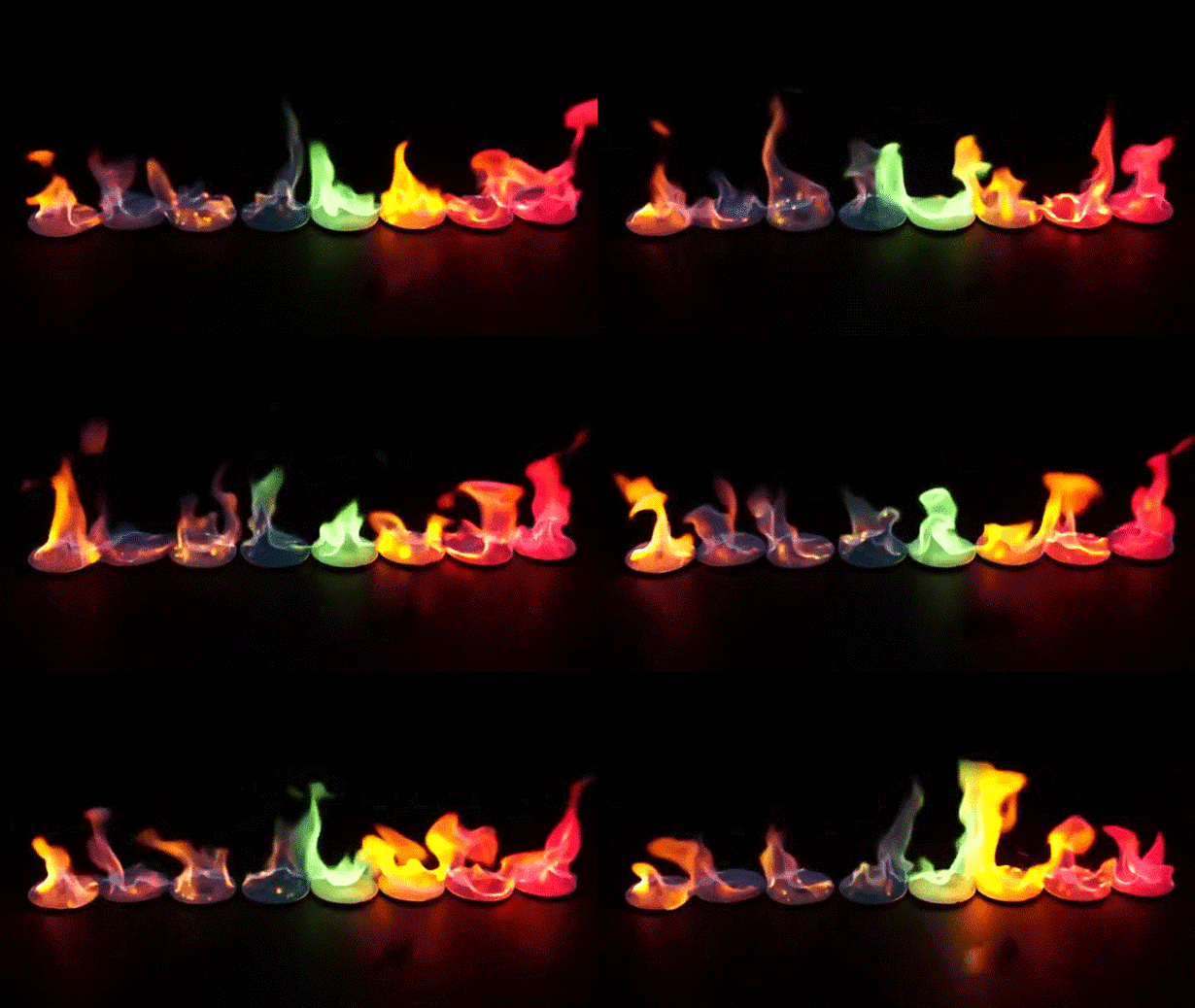
Chemical Reactions
Chemical reactions involve the rearranging of atoms to form new substances while obeying the law of conversation.
OBJECTIVES:
Chm.2.2.1 Explain the energy content of a chemical reaction.
Chm.2.2.2 Analyze the evidence of chemical change.
Chm.2.2.3 Analyze the law of conservation of matter and how it applies to various types of chemical equations (synthesis, decomposition, single replacement, double replacement, and combustion).
Honors Students:
Predict products for single replacement reactions.

The Mole & Stoichiometry
A mole is a unit of measurement used to calculate the number of atoms and molecules within a given mass or volume.
OBJECTIVES:
Chm.2.2.4 Analyse the stoichiometric relationships inherent in a chemical reaction.
Honors Students:
Determine limiting reactant
Calculate percent yield

Gases
The chemists Boyle, Charles, & Gay-Lussac were credited with finding the relationships between pressure, temperature, and volume. These relationships help us to predict and calculate how gases will change in real time.
OBJECTIVES:
Chm.2.1.5 Explain the relationships among pressure, temperature, volume, and quantity of gas, both qualitative and quantitative.
Honors Students:
Use graham's law appropriately.

Solutions, Acids, & Bases
In this unit, we will explore the solution making process as well as the definitions of acids and bases. Calculating concentration and pH will be the main focus of the math portion.
OBJECTIVES:
Chm.3.2.1 Classify substances using the hydronium and hydroxide concentrations.
Chm.3.2.2 Summarize the properties of acids and bases.
Chm.3.2.3 Infer the quantitative nature of a solution (molarity, dilution, and titration with a 1:1 molar ratio).
Chm.3.2.4 Summarize the properties of solutions.
Chm.3.2.5 Interpret solubility diagrams.
Chm.3.2.6 Explain the solution process.

Equilibrium
Chemical equilibrium occurs when the rate of the forward reaction equals the rate of the reverse reaction. In addition, if a stress is applied to a system at equilibrium the reaction will shift in order to relieve the stress according to Le Chatelier.
OBJECTIVES:
Chm.3.1.2 Explain the conditions of a system at equilibrium.
Chm.3.1.3 Infer the shift in equilibrium when a stress is applied to a chemical system (Le Chatelier’s Principle).

Final Exam
Yay!!! You've reached the end! For study purposes please review the powerpoints for each unit. You will find additional resources attached to the documents page.
